When Does a Persona Become Part of Who You Are?


Author’s note: Throughout this essay I use “woman” and she/her pronouns because I’m writing from my own lived experience of femininity and professional domination. Dominants can be of any gender, and the experiences I describe here aren’t intended to define dominance or femininity for anyone else.
When I became Mistress Sylvia, I expected for there to be a clear boundary between her and me.
Sylvia had a name, aesthetic and professional context. She occupied places that the rest of my life didn't. She was more controlled, decisive and way more comfortable being watched. She could ask directly for what she wanted and say no without softening it.
None of those qualities were entirely foreign to me, but they weren't qualities that came naturally to me, or at least from what I remember.
Growing up, I was bullied and painfully timid. I learned early that being noticed wasn't always a good thing. I became agreeable, cautious and very good at reading a room. If there was tension, I wanted to resolve it. If someone was unhappy with me, I wanted to understand why and fix it. Saying no could sometimes feel less like expressing a preference and more like creating a problem.
For a long time I thought those things were just features of my personality. Like maybe I was shy, or accommodating. I know I didn't like conflict. Some of that might have been temperament but some of it was almost certainly learned. What I find difficult now is determining where one ends and the other begins if that makes sense.
By the time I stepped into a professional identity that allowed me to behave differently, I had already spent years learning how to perform a certain version of myself.
I just hadn't thought of that one as a performance.
The Woman I Learned to Be
There are ways of being a woman that I learned so early that they stopped feeling learned. Rules like be pleasant, make other people feel comfortable, be (overly) humble, don't be "difficult", if you reject someone, do it gently. If someone's disappointed, explain yourself. If you want something, ask in a way that makes it easy for everyone else.
No one ever sat me down and handed me these rules. That's part of what makes them interesting. They actualize through praise, embarrassment, correction, observation and consequence until they feel less like behaviors than personality.
Being bullied probably made me especially sensitive to them. When you've already learned that attracting the wrong kind of attention can hurt, there's safety in being agreeable. There's safety in being easy to get along with. You learn to anticipate reactions before they happen. You become skilled at managing other people's impressions of you.
Then there are the expectations specifically attached to femininity. Women aren't the only people taught to perform gender. Men are too, but femininity is what I have the most lived experience with and has often seemed particularly concerned with managing the perception other people have of you.
Be attractive, but don't appear vain. Be sexually desirable, but not overtly sexual. Be independent, but not intimidating. Be confident, but still approachable. Have boundaries, but enforce them pleasantly and palatably.
Even modern ideas of female empowerment can contain contradictions. Women can be expected to be independent, ambitious, sexually liberated, emotionally intelligent, attractive, nurturing but somehow effortless about it all. The expectations change, but the awareness of being perceived doesn't.
Becoming Mistress Sylvia resulted in me finding a place where some of those expectations worked differently.
A Woman Who Didn't Need to Be Agreeable
Mistress Sylvia didn't need to make herself smaller because someone else was uncomfortable. Her authority didn't require an apology afterward. A command didn't need to disguise itself as a suggestion, and a no didn't require a paragraph explaining why.
At first, some of that felt unnatural to me. I stepped into a role where authority was expected of me, yet I still had years of practice doing almost the opposite.
It would be easy to tell this as a straightforward empowerment story. "A timid woman discovers her confidence and realizes that the powerful woman was inside her all along."
There's some truth in that, there are parts of Sylvia that feel less like inventions than permissions.
But I don't think it's that simple.
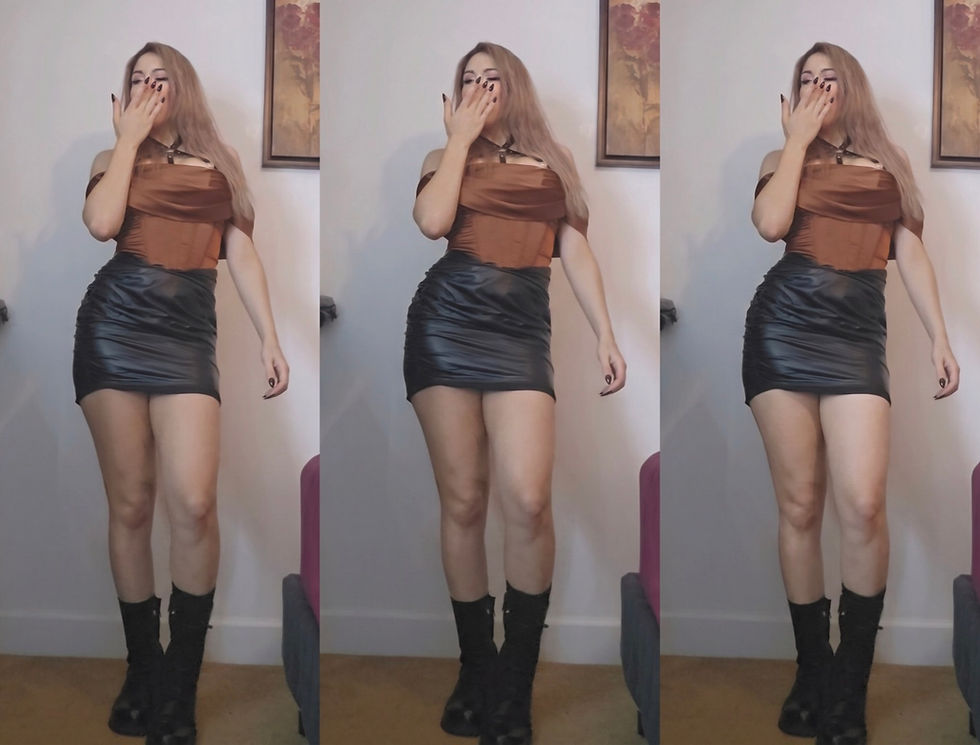
Professional domination can be a performance in the same sense that many professions involve performance. There are clothes, rituals, expectations, etc. The dominatrix in particular is a very recognizable feminine archetype: heels, leather, latex, controlled sexuality and exaggerated authority.
In some ways, she isn't an escape from feminine performance, she's femininity made theatrical. Sometimes, I see performances and presentations that remind me of drag, femininity deliberately exaggerated until the construction itself becomes visible.
That contradiction interests me more than just saying becoming a dominatrix made me feel empowered.
The dominatrix appears to reject conventional feminine submission while often looking feminine doing it. She might wear the heel higher, the waist tighter and the makeup sharper. She can exaggerate many of the same things women have historically been expected to use to attract attention.
But the direction of the interaction changes.
She's not presenting herself to be chosen, she's presenting herself as the person who chooses.
Who Is the Performance For?
My appearance is part of my profession. It would be disingenuous to say otherwise. I know photographs, clothing and fantasy affect how people perceive me, and I deliberately participate in constructing that image.
What felt different was having considerably more control over the terms of that perception.
I chose what was visible, the name attached to it, and the terms of which someone could approach me. I decided which requests I would entertain and which I wouldn't. I put a price on my time.
For someone who spent a lot of her life thinking about how she was perceived, there was something different about deliberately shaping the perception instead of adjusting myself in response to it.
The clothes didn't change their meaning on their own, my relationship to them did.
That made me wonder how often the meaning of "feminine" behavior depends not on what a woman is doing, but on who is presumed to have authority over the interaction. A heel can be an attempt to be desirable, it can also make someone taller. Sometimes it can do both.
That ambiguity follows me through professional domination. Things that look contradictory from the outside can coexist inside. Femininity and authority don't cancel each other out, neither do sexuality and control. Being looked at doesn't necessarily mean surrendering control over the looking.
And performing something doesn't necessarily mean it's not real.
The Separation Isn't Entirely My Choice
There's another complication in talking about Sylvia as a persona. The distance between my professional identity and the rest of my life isn't just psychological, some of it is practical.
I work in an industry that exists under unusual legal and social scrutiny. Where I live, sex work is illegal, and professional domination exists close enough to that legal and cultural boundary that stigma and perceived risk affect how openly I can connect different parts of my life. A professional name, separate accounts, different photographs and carefully maintained boundaries aren't simply aesthetic choices. They're ways of controlling how much one world can reach into another.
If I lived somewhere that treated sex work differently, I don't think I would feel the same need to maintain such a hard separation between Sylvia and the rest of myself.
I might still use a professional name. Writers, performers and people in conventional professions do that all the time. I'm sure I would still value privacy and enjoy the ritual of stepping into a professional identity.
But in that case the separation could be primarily just be about privacy, branding and context rather than also protecting the rest of my life from the consequences of allowing myself to exist as I want to.
That complicates the idea of a persona for me, because sometimes what looks like an intensely personal boundary is actually a response to stigma.
I live in a culture that can be fascinated by a dominatrix while remaining deeply uncomfortable with the woman who does the work. We can consume fantasies at a distance while attaching very real consequences to the people who provide them.
When Sylvia Started Following Me Home
The strangest part came when qualities I associated with Sylvia started appearing elsewhere in my life.
Not the theatrical ones, I didn't start treating ordinary life like a session. The changes were much smaller and probably more significant.
I became better at allowing someone else to be uncomfortable without immediately rescuing them from the discomfort. A huge one is that I became more willing to say what I meant instead of constructing the least offensive possible version of it. I got better at recognizing the difference between being unkind and simply disappointing someone, which is particularly liberating.
When you've spent years being agreeable, another person's disappointment can feel like evidence that you've done something wrong. It took practice for me to understand that sometimes people are disappointed because they wanted something from you and you said no.
Professional domination gave me an unusual environment to practice that in.
Direct communication in this work is absolutely necessary. Boundaries have to be articulated and being vague can become a real problem. Confidence affects the entire experience you're creating. You can't apologize for occupying a position you've explicitly been entrusted to occupy.
What If Personality Is Partly Practice?
The first time you state a boundary, it can feel a little aggressive depending on your upbringing and life experiences. The fiftieth time, it's just a normal sentence.
That makes me wonder how much of what I thought was my personality was just muscle memory.
If accommodation can be practiced, authority can be too. If I spent years rehearsing one without realizing I was rehearsing it, what would happen if I deliberately practiced the other?
We tend to talk about personality as something we possess. Someone is confident, or shy. Someone is assertive, or maybe agreeable. But many of the behaviors we use as evidence of having those traits are also behaviors that become easier to demonstrate through repetition.
But that doesn't mean temperament isn't real, becoming Mistress Sylvia didn't erase the person who would rather avoid unnecessary conflict. But now sometimes when I feel the old response forming, the explanation, apology, I can just decide not to use it.
Did Sylvia uncover an assertive part of me that had always existed?
Or did repeatedly practicing assertiveness strengthen something that had previously been much smaller?
I don't know.
I suspect we're drawn to the first explanation because it preserves a comforting idea, that somewhere underneath all our conditioning is a stable, authentic self waiting to be discovered, but I'm not so sure of that.
Liberation, or Another Kind of Performance?
There's an appealing version of this story where I shed patriarchal conditioning, discover my authentic female power and emerge as the woman I was always supposed to be.
But I don't quite believe that's happened either.
Becoming a dominatrix didn't remove me from the culture that shaped me. I still operate in a world that places enormous value on women's appearance. My business exists within that reality. I can reject certain expectations while benefiting from others. I can exercise authority while embodying a highly recognizable sexual archetype.
The dominatrix herself is not culturally neutral. The archetype has been shaped by other people's ideas about women, sex, femininity and power. If conventional femininity contains performance, putting on latex doesn't magically transport me away from the theater.
So I hesitate to call one version of myself conditioned and the other liberated.
What Sylvia may have given me instead was something less grandiose but more useful, she made the performance visible and perceptible to me.
When you consciously develop a professional persona, you can see some of the machinery. You notice which behaviors produce which reactions. You become aware that you're deciding how you want to occupy a room.
Once I could see those choices clearly in Sylvia, it became harder not to notice how many choices, expectations and habits were shaping me everywhere else.
Which One Is the "Real" Woman?
We tend to talk about personas as though there's a real person underneath and an artificial one layered on top, like a mask.
But what if the woman underneath has masks too?
I've been the timid girl trying not to attract the wrong attention, as well as the agreeable one trying to keep the peace. I've occupied identities built around relationships, responsibility and what other people needed from me. I'm also Mistress Sylvia, a woman who can walk into a room expecting to be listened to.
Which one is me?
The obvious answer is all of them, but that doesn't satisfy me. It suggests there's some separate, stable "me" collecting identities or something.
Some identities are chosen, others are assigned. Some begin as survival strategies, and some we occupy because of family, gender, work or relationships. Some are reinforced by the laws and social consequences surrounding us. But eventually I think they all leave something behind.
That doesn't make them false, but it makes authenticity more complicated than I thought it was.
Mistress Sylvia is one of the few versions of myself whose development I can remember consciously. I watched my confidence grow, I watched behaviors that initially required effort become natural, I watched boundaries that once felt confrontational begin to feel ordinary. I know Sylvia was cultivated because I was there while it happened.
What I hadn't considered was how much the woman doing the cultivating had been cultivated too.
-Mistress Sylvia